
Parents and caregivers are vital in shaping their children’s understanding of healthy, respectful relationships. When parents engage in open, positive, and trusting conversations about relationships and dating, they help their children develop the skills and confidence to build safe, healthy connections that reduce the risk of dating violence.
Resources For Parents & Caregivers
How to use the FAQs:
Want to learn more? Simply click on the questions below to get practical guidance and tools that you can use as a parent to support your child’s healthy relationship skills!

When you click a question, you will see up to three parts to help you find the information that fits your needs:
- Quick answer: A brief, straight-forward response for when you want the essentials fast – perfect if you only have a minute or two.
- ConnectED Parents tip: A practical skill, strategy, or suggestion from the ConnectED Parents program related to the question. This section is great when you have a few extra minutes and want to dig deeper and try new skills with your child.
- Additional resources: Links to articles, videos, and websites if you want to explore the topic further – best if you have more time to read, watch, and learn.
What is dating?
Quick Answer
For many of parents, the dating world our kids navigate might feel quite different from what we experienced. Understanding today’s adolescent dating landscape is really important, as research shows early dating experiences significantly shape future relationships and emotional wellbeing. By getting a clearer picture of dating norms, we can better prepare our young people to navigate these experiences safely.
Adolescent dating refers to mutually acknowledged romantic relationships between young people, typically during the teenage years. These relationships can involve emotional closeness, companionship, and, for some, sexual involvement.
Additional Resources
- Learn more about adolescent dating: https://www.verywellfamily.com/five-truths-teens-and-dating-2611146
- Video where adolescents talk about healthy relationships:
What is adolescent dating violence?
Quick Answer
Adolescent dating violence (ADV) is a serious issue that can have lasting impacts on young people’s wellbeing. Understanding how common and complex ADV is helps us take the first crucial steps towards preventing it and supporting those affected.
Adolescent dating violence (or teen/youth dating violence) happens when one person abuses power to control, threaten, manipulate, or be aggressive to another in a romantic relationship.
In Canada, 1 in 3 high school students experience dating abuse.1 Adolescent dating violence can have long-lasting consequences, including depression, suicidality, substance misuse, and anxiety. Youth who experience adolescent dating violence are at greater risk of experiencing adult domestic violence. This is why prevention is key.
Additional Resources
- Learn more about adolescent dating violence:
- The “Teen Power and Control Wheel” helps to explains the key drivers of ADV: https://safeandrespectful.org/wp-content/uploads/Teen-Power-and-Control-Wheel.pdf 2
References
1 Exner-Cortens, D., Baker, E., & Craig, W. (2021). The National Prevalence of Adolescent Dating Violence in Canada. The Journal of adolescent health : official publication of the Society for Adolescent Medicine, 69(3), 495–502. https://doi.org/10.1016/j.jadohealth.2021.01.032
2 Domestic Abuse Intervention Project. (n.d.). Teen power and control teen wheel. National Centre on Domestic and Sexual Violence. https://www.stopfamilyviolence.pe.ca/sites/www.stopfamilyviolence.pe.ca/files/StopFamilyViolence_2020/css_teenwheel2.pdf
What can parents do to prevent adolescent dating violence?
Quick Answer
As parents, we play a vital role in preventing adolescent dating violence (ADV) before it starts. Research shows that our involvement, open conversations, and promoting healthy relationships skills at home can help protect young people from ADV. Teaching skills like assertive communication, conflict resolution, and boundary-setting are key for preventing ADV. Many factors in our society create the conditions that lead to ADV, but parents can significantly help create safer environments for young people.
ConnectED Parents Tip:
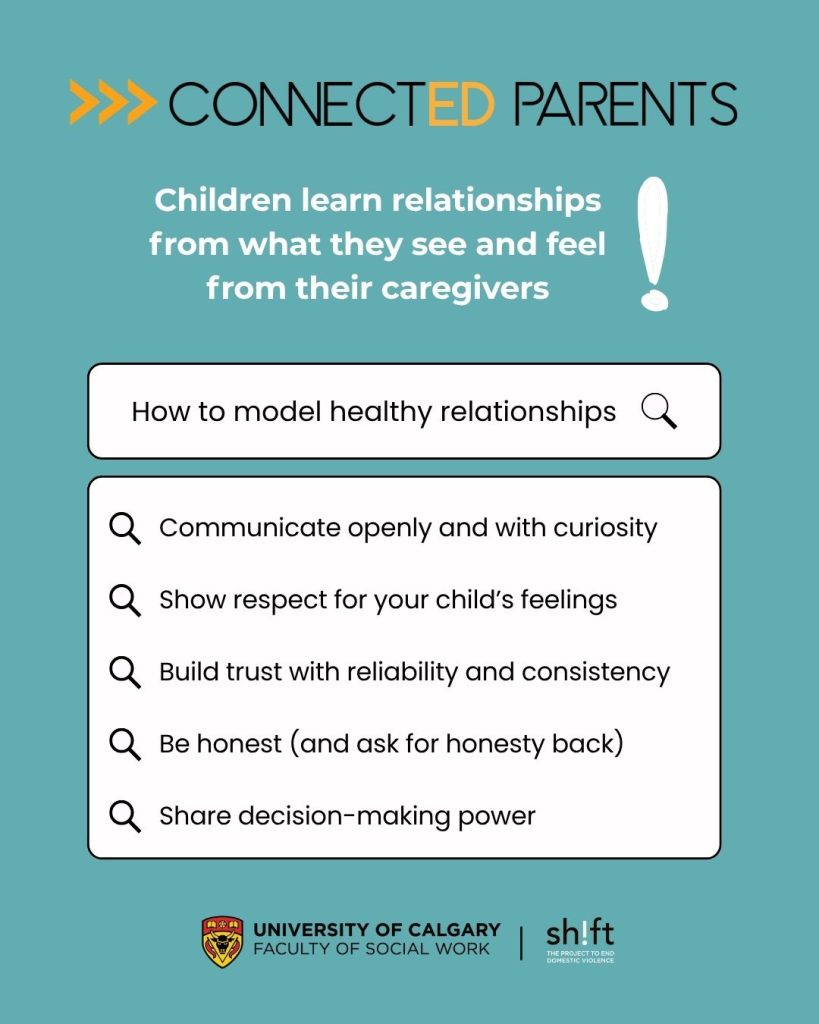
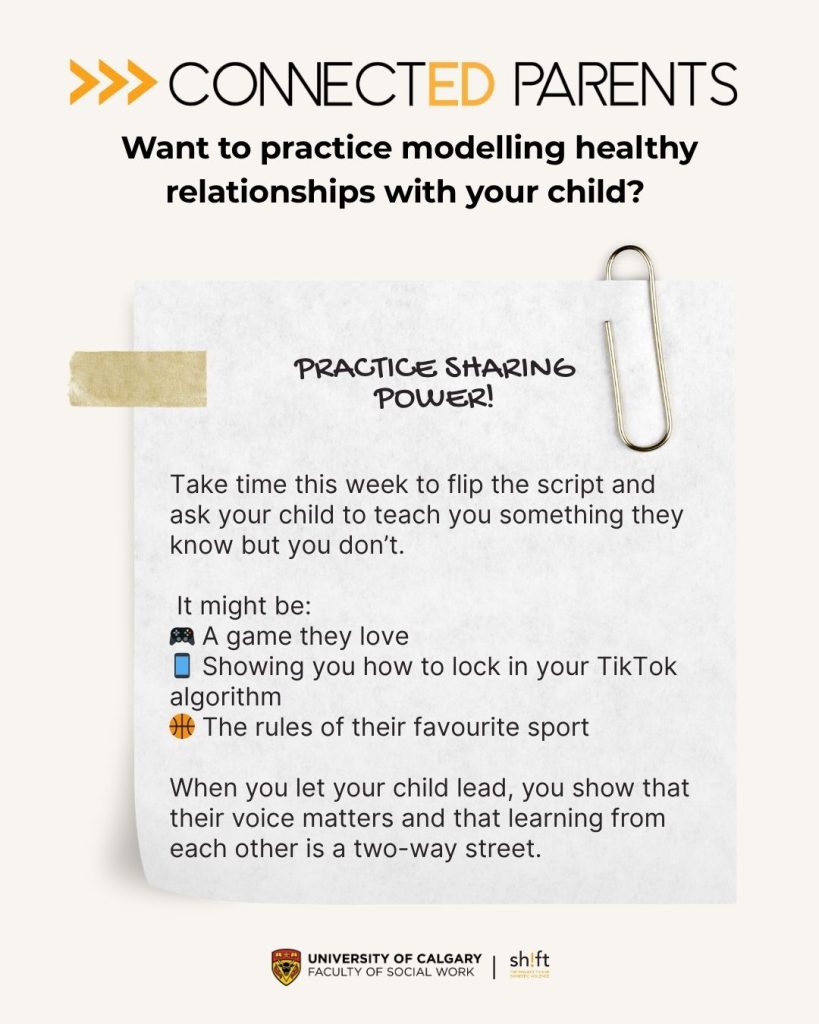
Model healthy relationships to foster healthy relationships skills in our children.
Access more tips over at our Instagram @connected_parents_canada
Additional Resources
- Learn more about a holistic, broad approach to violence prevention: https://www.cdc.gov/violence-prevention/about/index.html
What is the spectrum of relationships and how can parents support healthy ones in their children?
Quick Answer
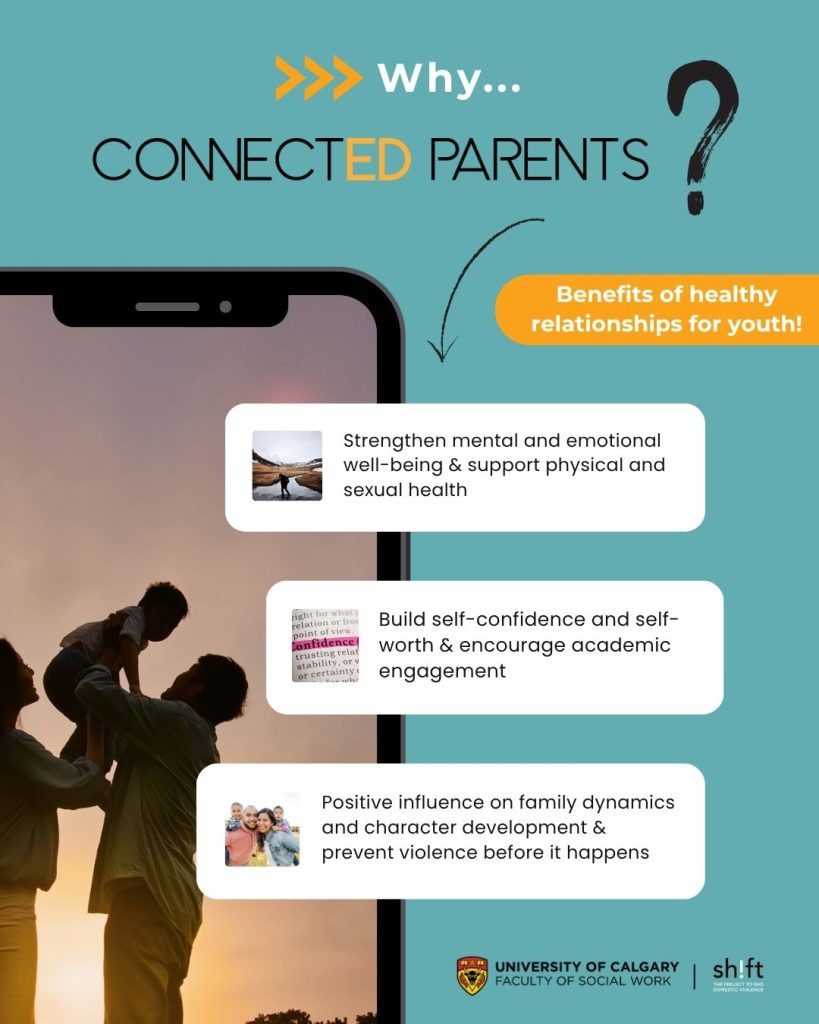
It’s important for young people to understand the full range of relationships – from healthy to unhealthy and abusive. This understanding helps them make safer choices. Evidence suggests that children and youth who can identify characteristics of healthy relationships are better at forming positive connections and recognizing warning signs of adolescent dating violence.
Generally, in healthy relationships, both partners are communicating, respectful, trusting, honest, equal, and making mutual choices. In unhealthy relationships, partners may be disrespectful and dishonest. Abuse is occurring when someone is communicating in a hurtful or threatening way, controlling, and isolating their partner from others.
ConnectED Parents Tip:
Talking about abuse is not easy, but you can start by talking to your children about the benefits of healthy relationships.
Access more tips over at our Instagram @connected_parents_canada

Additional Resources
- Learn more about the spectrum of relationships: https://www.loveisrespect.org/everyone-deserves-a-healthy-relationship/relationship-spectrum/
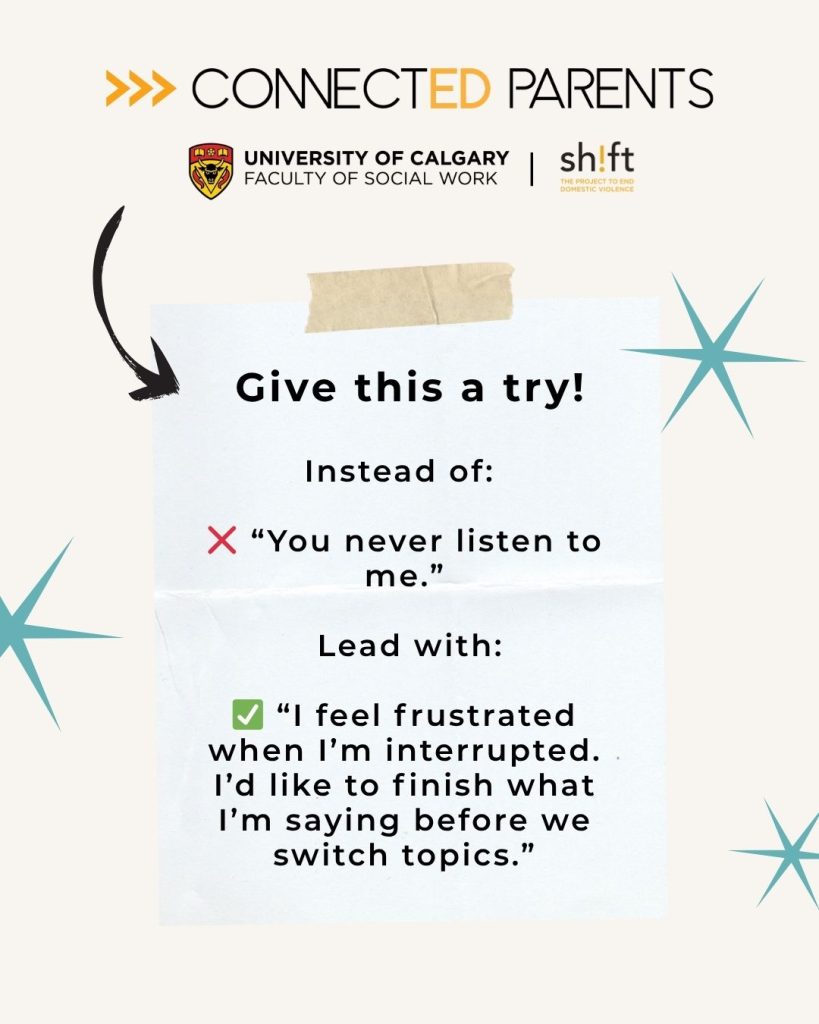
How can I foster assertive communication in my child?
Quick Answer
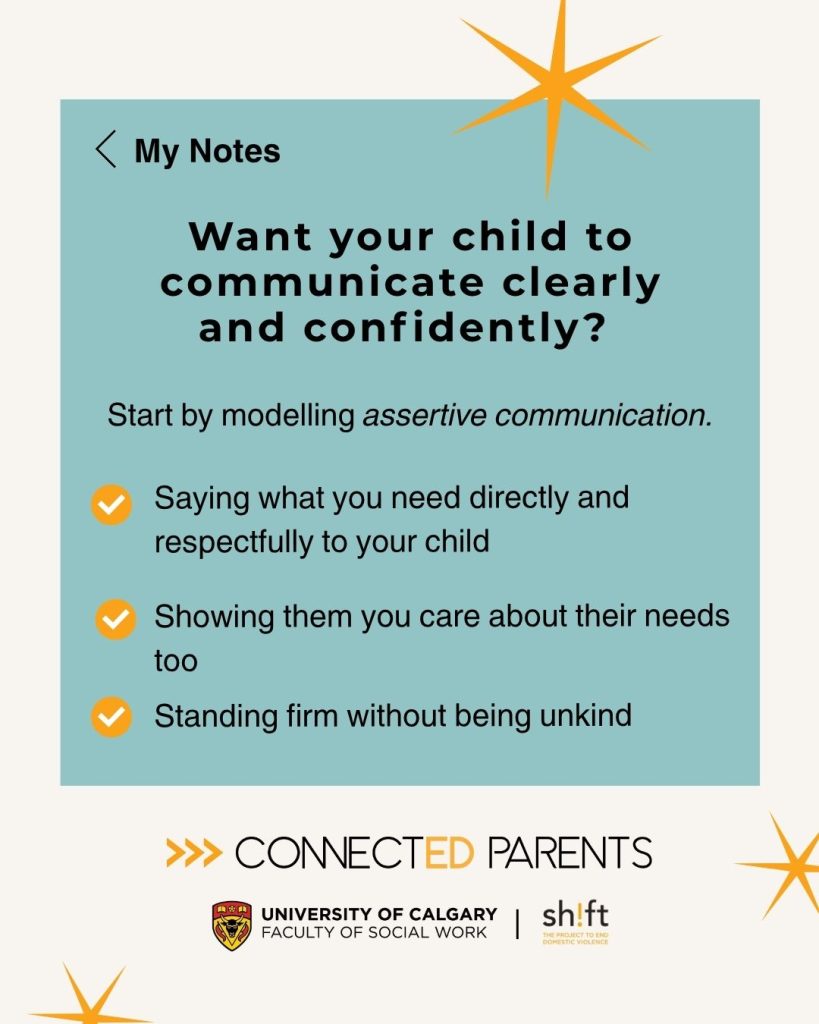
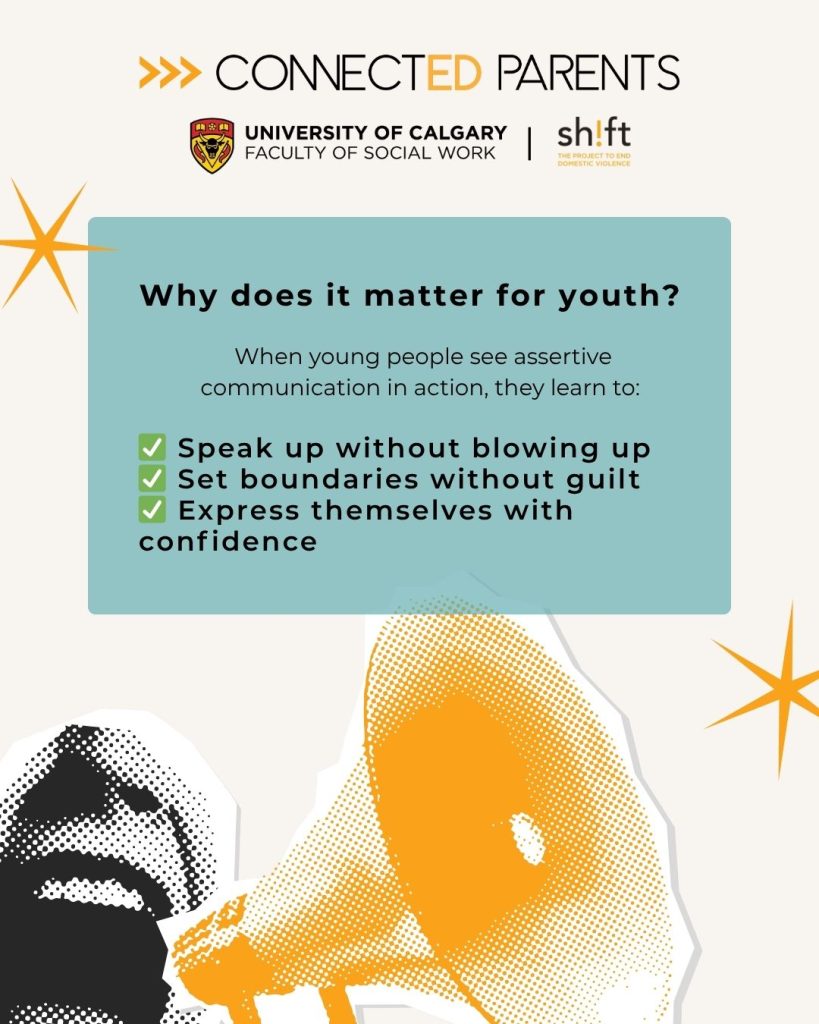
Assertive communication is a life skill that is crucial for healthy interactions and preventing harm in relationships.
- Assertive communication is expressing our thoughts, feelings, and needs clearly, directly, and respectfully.
- Assertive communication is different from passive communication, where we don't express our feelings or needs and prioritize others' needs over our own.
- Assertive communication is also different from aggressive communication, where we ignore others' feelings and focus on winning the argument.
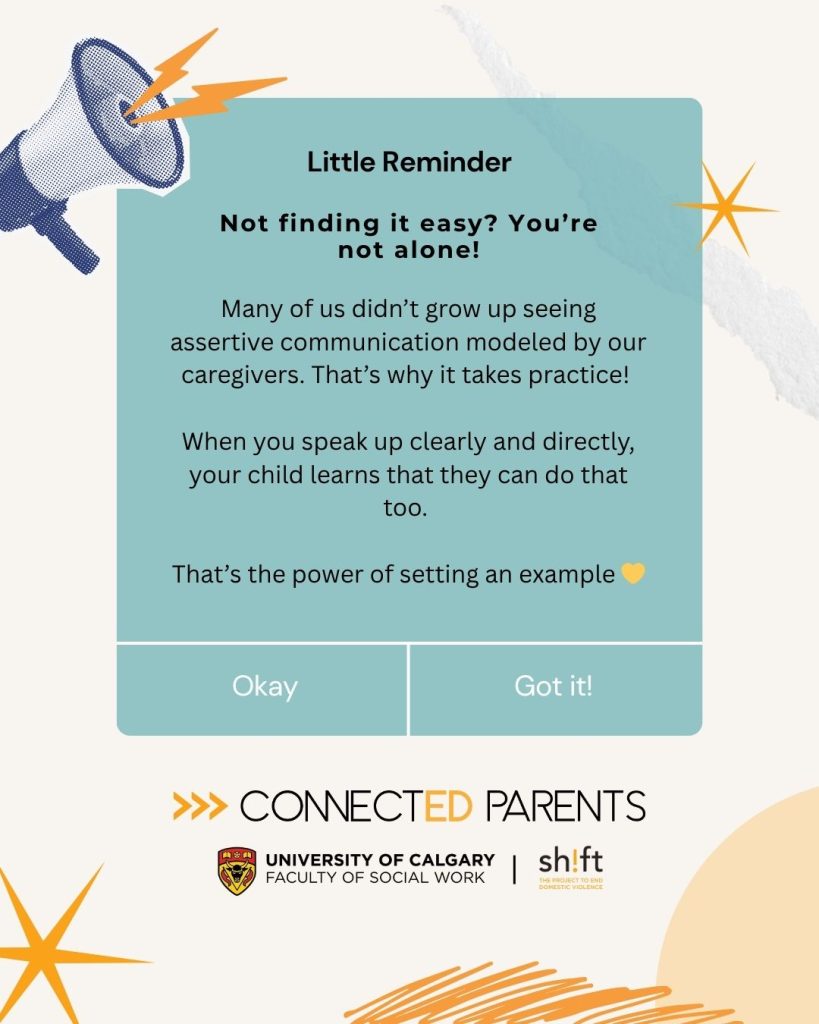
- When parents have assertive communication skills themselves, they are modeling this skill for their children, which is key to helping our children learn this skill too.
ConnectED Parents Tip:
Learn and teach assertive communication - it's key to helping your child build and maintain healthy relationships.
Access more tips over at our Instagram @connected_parents_canada
How can I build conflict-resolution skills in my child?
Quick Answer
Conflict is very normal in relationships and we all have different feelings it! Some of us might try to avoid conflict at all costs, and others might be very comfortable with it. This likely has something to do with how we saw conflict play out in our families. Research shows that children who learn how to navigate through conflict constructively are better equipped to express their perspectives, understand others’ viewpoints, and foster healthier relationships.
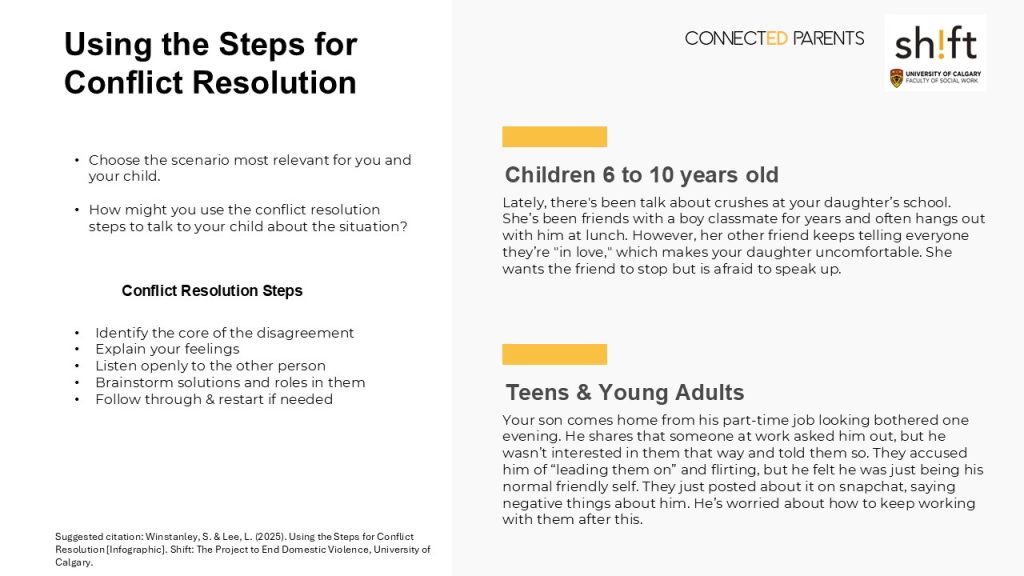
- Conflict resolution usually involves moving through a disagreement or argument towards a solution that everyone can agree to.
- Conflict differs from abuse. For example, abuse can involve degrading or humiliating comments, or fear of retaliation, or harm when someone expresses their thoughts or feelings.
ConnectED Parents Tip:
Learn and teach the steps for conflict resolution so your child can work through relationship challenges.
Access more tips over at our Instagram @connected_parents_canada
Additional Resources
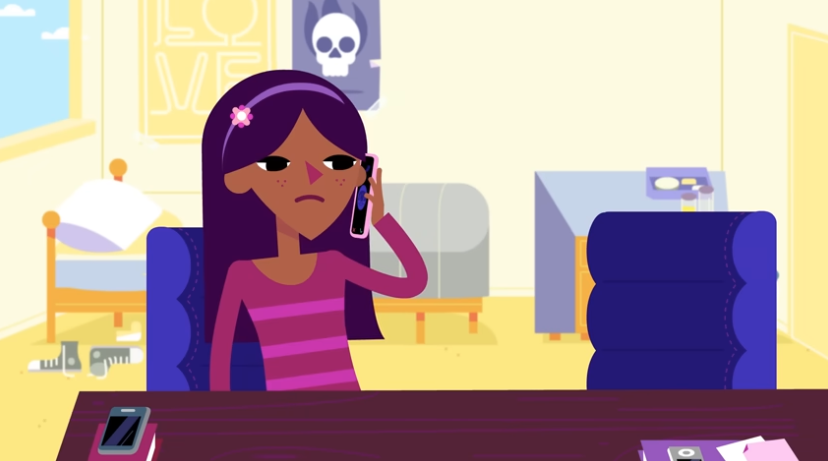
- Learn more about conflict through this video:
How can I help my child learn and set boundaries?
Quick Answer
Boundary-setting is a fundamental part of healthy relationships, allowing individuals to define and communicate their needs, limits, and expectations.
- Boundary-setting can be described as communicating about the things that help us to protect and nurture our own needs, wants, desires and abilities. This also helps us respect these things for others.
- There are all kinds of different boundaries. For example, time boundaries might involve communicating about how often a teen wants to hang out with a crush or friend. Emotional boundaries might involve how comfortable each person is saying "I love you" in a relationship. Digital boundaries could be something like, "I don't respond to texts or messages after 10pm."
ConnectED Parents Tip:
Learn and teach the Head, Heart, Body technique to help our children identify their own boundaries.
Access more tips over at our Instagram @connected_parents_canada

Additional Resources
- Review an example of a boundary-setting tool: https://www.centreforsexuality.ca/learning-centre/am-i-ready-for-sex/
What are the signs of adolescent dating violence?
Quick Answer
Spotting the signs of adolescent dating violence (ADV) early is crucial for ensuring the safety and wellbeing of young people. As parents, staying educated on ADV warning signs can help us respond effectively and guide our children toward healthier relationships and away from harmful ones.
Here is an informative resource on the signs of ADV: https://www.prevnet.ca/teen-dating-violence/signs-of-dating-violence/
What are helpful ways to address adolescent dating violence?
Quick Answer
When our children are experiencing or using dating violence behaviours, how parents respond matters. Learn about research-backed ways to address ADV: https://www.prevnet.ca/teen-dating-violence/for-parents-and-caregivers/when-violence-is-disclosed/
How can I build a closer relationship with my child so we can talk about healthy relationships?
Quick Answer
A strong parent-child relationship built on trust and open communication can protect against adolescent dating violence (ADV). When children feel connected to and understood by their parents, they are more likely to seek guidance and share concerns.
Practicing active listening, a core communication skill, strengthens relational bonds and creates a safe space for discussing sensitive topics like healthy relationships.
Additional Resources
- Learn more about active listening for parents: https://raisingchildren.net.au/pre-teens/communicating-relationships/communicating/active-listening
How can I support other parents to learn and teach healthy relationships skills?
Stay tuned! We will share resources and tools soon.
What community resources would you recommend if I need support?
Quick Answer
If you want support, there are many services locally and nationwide. Here is list that we have compiled: https://preventdomesticviolence.ca/wp-content/uploads/2023/08/Resources-for-ConnectED-Parents-Participants.pdf
Last updated December 2025
Shift works across Alberta on Treaty 4, 6, 7, 8 and 10 territories. These are traditional travelling routes, gathering places, and meeting grounds for many Indigenous Peoples, including the Blackfoot Confederacy (comprised of the Siksika, Piikani, and Kainai First Nations); Tsuut’ina First Nation; Stoney Nakoda (including the Chiniki, Bearspaw, and Goodstoney First Nations); Cree; Saulteaux; Nakota Sioux; Dene; and the Métis Nation in Alberta (across Districts 1-22).
We respect the Treaties that were made, acknowledge the ongoing harms of colonial violence, and dedicate ourselves to moving forward in partnership with Indigenous communities in a spirit of reconciliation and collaboration.

Initiated by The Brenda Strafford Chair in the Prevention of Domestic Violence
HOME / WHAT’S NEW / CONTACT US / LOGIN / DONATE / TERMS & CONDITIONS